

What Is the Best Harness Booster Seat for Secure Fit?
Last Updated: October 25, 2026
Quick Summary
The best harness booster seat for secure fit is one whose harness weight and height limits match your child, with the harness height ceiling checked first because tall torsos outgrow it before weight. Confirm the pinch test passes at the collarbone, the chest clip sits at armpit level, and the seat moves less than an inch at the belt path.
- A harness holds your child in place, while a booster only positions the vehicle's seat belt across the body.
- If you can pinch a horizontal fold of webbing at the collarbone, the harness is too loose and needs tightening.
- A common pattern is a harness rated to roughly 65 pounds and a booster rated to roughly 100 to 120 pounds.
- Most manufacturers print a usable-life window commonly in the six-to-ten-year range depending on the model.
- Nothing should go under the harness that didn't come in the box, since added bulk changes how it tightens.
Table of Contents
- Harnessed Seat or Belt-Positioning Booster: What Actually Protects Your Child
- Car Seat Harness Too Loose Signs Every Parent Should Catch
- How to Tighten a Car Seat Harness Without Overcorrecting
- Best Harness-to-Booster Car Seats: What to Compare Before You Buy
- Car Seat Harness Covers Safety: What Adds Protection and What Compromises It
- Vehicle-Specific Fit and Installation Problems to Troubleshoot
- Check Your Child's Fit Before Your Next Drive
- Frequently Asked Questions
Harnessed Seat or Belt-Positioning Booster: What Actually Protects Your Child
A harness booster seat is a combination child restraint that runs a five-point harness in its early configuration, then converts to a belt-positioning booster once your child outgrows the harness limits.
At BuckleBuddeez, we hear from parents who assume these are interchangeable. They aren't. Consumer Reports' harness-booster testing evaluates these seats on crash protection, ease of use, and fit, and those three criteria are exactly where the two modes diverge.
How a Five-Point Harness Distributes Crash Forces
A five-point harness spreads crash energy across the two shoulders, two hips, and the crotch strap. That spread keeps a small body from sliding forward or twisting sideways in a sudden stop.
The chest clip holds the straps together at armpit level. It does no load-bearing work in a crash, but it keeps the shoulder straps from slipping off narrow shoulders before impact.
Car Seat Harness Too Loose Signs Every Parent Should Catch
The clearest sign of a loose harness is slack at the collarbone that you can pinch into a fold. For a deeper walkthrough of signs your car seat harness is too loose, see our full guide.
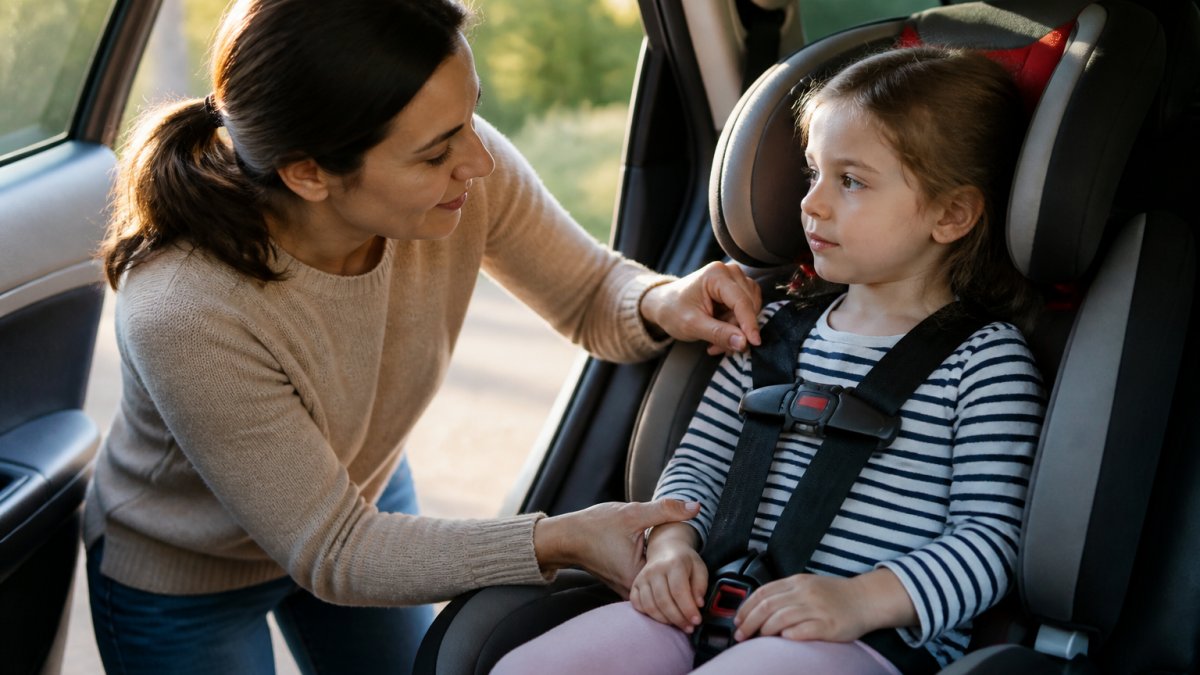
Other signs worth catching early:
- Straps that slide off the shoulders when your child leans forward
- A chest clip sitting at the belly instead of armpit level
- Twisted webbing running through the buckle or belt path
Twisted straps are the sneaky one. They look tight but distribute force unevenly, and they're often why a buckle ends up buried under a folded strap.
The Pinch Test and Other Quick Checks
The pinch test takes five seconds. Buckle your child in, tug the shoulder strap near the collarbone, and try to pinch the webbing. No fold means the fit is snug.
Pair it with the chest clip check (armpit level, always) and a visual pass for twists. Safe Kids Worldwide recommends keeping a child in the harness only while they remain within the seat's stated weight or height limits, so pair every fit check with a limits check.
How to Tighten a Car Seat Harness Without Overcorrecting
Tighten a car seat harness by pulling the adjuster strap until the pinch test passes, then stopping. Overcorrection is a real problem: a harness pulled too tight presses into the shoulders and can push a child to unbuckle or wiggle loose mid-drive.
Work through it in order:
- Loosen the harness fully before seating your child.
- Buckle the chest clip first, then the crotch buckle.
- Remove slack from the hip straps before the shoulder straps.
- Pull the adjuster strap in short increments, checking after each pull.
- Confirm the chest clip sits at armpit level.
- Run your fingers along the webbing to catch twists.
If the harness won't tighten smoothly, check for a twisted strap first. BuckleBuddeez silicone sleeves are designed to stop twisted car seat straps for good.
Best Harness-to-Booster Car Seats: What to Compare Before You Buy
Most buying guides hand you a winner and move on. That approach fails for harness-to-booster seats because the right seat depends on your child's measurements, your vehicle, and how long you intend to use each mode.
Consumer Reports' harness-booster testing evaluates these seats on crash protection, ease of use, and fit. Those are the right categories, but the scores only matter once you confirm the seat's stated limits match your child.
| Criterion | What to Verify | Where to Find It | Why It Decides the Purchase |
|---|---|---|---|
| Harness weight limit | Maximum weight in harness mode | Seat label and manual | Sets the point the harness retires |
| Harness height limit | Top harness slot height | Manual specification page | Tall torsos outgrow height before weight |
| Booster weight and height range | Minimum and maximum for booster mode | Manual and label | Confirms the seat still fits after conversion |
| Belt-fit geometry | Shoulder belt guide height range, lap belt path | Product specifications | Determines whether the belt lands correctly on your child |
| Expiration | Manufacture date and usable life | Stamped on shell or label | An expired seat should not be used regardless of condition |
Current Model Limits and Expiration Details
Limits vary by model and by configuration, so treat any number you read online as a starting point and confirm it on the seat you actually own.
Expiration matters just as much. Most manufacturers print a manufacture date and a usable-life window on the shell or label, commonly in the six-to-ten-year range depending on the model. Check that date before buying used, and check it again before passing a seat to a younger sibling.
How We Evaluate These Seats
Transparency about method matters as much as the recommendation. When evaluating these seats, consider five factors:
- Fit range, how wide a span of child heights and weights the seat covers in both harness and booster modes, based on the manufacturer's published limits.
- Belt-fit geometry, whether the shoulder belt guide and lap belt path place the belt correctly across a range of child sizes, checked against independent booster-fit ratings where available.
- Ease of use, buckle access, harness adjustment, headrest and back-height adjustment, and installation steps, judged against the features that reduce install errors.
- Vehicle compatibility, seat depth, head restraint clearance, and lower-anchor or seat-belt routing across common vehicle types.
- Documentation quality, whether the manual clearly states limits, expiration, and conversion steps.
Crash protection is table stakes, not a differentiator, because every seat sold must meet Federal Motor Vehicle Safety Standard 213. The differentiator is whether the seat fits your child and your vehicle through every stage of use.
Weight and Height Limits That Decide When the Harness Retires
The harness retires when your child hits the seat's stated weight or height ceiling, whichever comes first.
Check the label, not your child's age. A tall, long-legged five-year-old may outgrow harness height before a shorter six-year-old does. When you compare seats, put the harness height ceiling first and the weight ceiling second, because height is the limit that arrives without warning.
Car Seat Harness Covers Safety: What Adds Protection and What Compromises It
Aftermarket harness covers and strap sleeves are safe only when they don't sit between the harness and the child's body in the load path.
The practical rule: nothing goes under the harness that didn't come in the box. Our guide to car seat accessories that are safe and worth buying covers harness covers and other add-ons in more detail.
BuckleBuddeez takes that second approach. The slim silicone sleeves keep webbing flat and aligned so straps don't twist and buckles stay upright and reachable.
Vehicle-Specific Fit and Installation Problems to Troubleshoot
Most "bad seat" complaints are actually vehicle fit problems. Seat depth, headrest angle, buckle stalk length, and seat-belt geometry all change how a harness-to-booster performs in your car, and the same seat can be secure in one vehicle and marginal in another. Work through the geometry before you blame the seat.
Seat-Belt Geometry and Buckle Placement
A belt-positioning booster depends entirely on the vehicle belt landing in the right place. Two measurements drive that:
- Shoulder belt anchor height. If the anchor sits too low, the belt crosses the neck or upper arm instead of the mid-shoulder. If it sits too high, the belt rides away from the chest. Adjustable shoulder anchors and the booster's own belt guide are the tools that correct this.
- Buckle stalk length and stiffness. A long, floppy buckle stalk can press into the booster's armrest or sit under the child's thigh. A short, rigid stalk can make the buckle hard to reach. Check that the booster's belt path routes cleanly and the buckle does not press into the seat or the child.
Seat-belt geometry also varies by seating position. The center rear seat often has a different belt anchor layout than the outboard seats, and some center positions use a lap-only belt that cannot be used with a belt-positioning booster. Confirm the seating position's belt type before installing.
Head Restraints and Seating Position
A vehicle head restraint that pushes the booster forward can prevent the seat from sitting flat on the vehicle seat. If the manual allows, remove or raise the head restraint so the booster's back rests against the seat back.
Seating position choice matters for harness mode too. The rear seat is the recommended place for children under 13, per widely published child-passenger safety guidance, and the center rear position is often preferred when it can be used with a proper installation.
Installation Troubleshooting Checklist
Troubleshoot in this order:
- Buckle buried in the seat crease: a common fit issue with deep contoured seats.
- Headrest pushing the seat forward: remove or raise the vehicle headrest if the manual allows it.
- Seat belt buckle stalk too long: check whether the booster's belt path routes cleanly without the buckle pressing into the seat.
Compatibility Across Vehicle Types
Vehicle type shapes the problem. Compact sedans often have short seat cushions that leave a booster's front edge unsupported. SUVs and minivans frequently have deep seat contours and long buckle stalks. Pickup trucks may have narrow rear seats and limited head restraint adjustment. In each case, the fix is the same: confirm the booster sits flat, the belt routes through the guide without binding, and the buckle is reachable without digging into the seat.
Check Your Child's Fit Before Your Next Drive
Run this checklist every time your child changes seats, seasons, or vehicles:
- Pinch test passes at the collarbone
- Chest clip at armpit level
- No twists anywhere in the webbing
The gap between a harness that protects and one that merely restrains comes down to fit, and fit degrades quietly as kids grow and straps twist.
Frequently Asked Questions
How tight should a car seat harness be?
The harness should sit snug enough that you cannot pinch any slack in the strap at the child's shoulder. Run two fingers along the webbing at the collarbone; if the fabric folds between your fingers, tighten it. The chest clip belongs at armpit level, and the shoulder straps should come from at or just below the shoulders for rear-facing children. A snug harness keeps the child positioned correctly so the seat can absorb crash forces. Check tightness every trip, since clothing layers and growth change the fit.
What are the signs a car seat harness is too loose?
Common car seat harness too loose signs include straps that slide off the shoulders, a chest clip that sits near the belly instead of the armpits, webbing you can pinch at the collarbone, and a child who can lean forward well past the seat back. Twisted straps and buckles buried under the child's legs are also red flags. Any one of these means the harness is not holding your child in the crash position, so stop and adjust before driving.
Can harness covers or strap sleeves affect car seat safety?
Car seat harness covers safety depends on what the product touches. Thick, puffy covers placed between the child and the harness add bulk that hides a loose fit and are not allowed by most manufacturers. Slim sleeves that wrap the webbing below the chest clip keep straps flat and untwisted without changing the belt path, and BuckleBuddeez reports passing dynamic crash testing on FMVSS 213 sleds with a measurable reduction in chest g-force acceleration. Always confirm a product is compatible with your specific seat.
When can a child switch from a harness to a booster seat?
Safe Kids Worldwide recommends keeping the five-point harness only while the child stays within the seat's stated weight and height limits. Once your child outgrows those limits, move to a belt-positioning booster and check that the lap belt crosses the hips and the shoulder belt sits across the middle of the shoulder. Many combination seats convert from a harness to a booster, so you may not need a new seat at all.
Twisted straps and buried buckles make a snug fit harder to hit every single time, especially with multiple kids and multiple cars. BuckleBuddeez keeps harness webbing flat and buckles upright with slim silicone sleeves that fit standard five-point harnesses, stay flexible in cold weather, and clean up in the dishwasher. Get started with BuckleBuddeez and make every buckle-in faster, calmer, and correctly fitted.
