

Car Seat Buckle Gadgets That Actually Work
Last Updated: October 23, 2026
Quick Summary
Yes, effective gadgets exist, but only strap sleeves or aligners that keep the webbing flat and the car seat buckle upright. Avoid buckle covers, extenders, duct tape and knots, since these are rarely approved and never crash tested with your seat. BuckleBuddeez silicone sleeves are tested on FMVSS 213 sleds and cost $29.99 per pair.
- Any product touching the harness must be approved for your specific seat or it does not belong on the seat.
- Buckle covers and extenders are rarely approved and change how the buckle latches, releases, or sits.
- Move the crotch buckle to the position closest to your child without pressing into their body.
- A loose harness is the leading cause of the buried-buckle problem, so tighten until you cannot pinch slack at the shoulder.
- If your child can unbuckle a properly fitted harness, consult a certified child passenger safety technician.
Table of Contents
- Why Car Seat Buckles End Up Buried (And What Actually Helps)
- Car Seat Accessories Safety: What Manufacturers and Regulators Approve
- Car Seat Buckle Cover Safety: Why Most Aftermarket Covers Fail the Test
- Car Seat Buckle Extender Safety: The Hidden Risks of Extending the Buckle
- How to Stop Car Seat Straps From Twisting: Fixes That Hold Up in a Crash
- Adjusting the Crotch Buckle and Harness So the Buckle Stays Reachable
- Escape Artists and Unbuckling: Behavioral Fixes Backed by Child Passenger Safety Experts
- Conclusion
- Frequently Asked Questions
Why Car Seat Buckles End Up Buried (And What Actually Helps)
Car seat buckles get buried for one main reason: the harness webbing twists, and the buckle tongue slides down into the seat crease where you cannot reach it.
At BuckleBuddeez, we hear this complaint constantly from parents of toddlers and infants alike. The fix is not a gadget that hides the buckle.
Here is the short answer: yes, effective gadgets exist, but only the ones that work with the harness rather than against it.
Car Seat Accessories Safety: What Manufacturers and Regulators Approve
Car seat accessories safety starts with one rule: any product that touches the harness must be approved for use with that specific seat, or it does not belong on the seat.
Federal rules are clear about what a car seat must do. The Federal Motor Vehicle Safety Standard 213 sets the crash performance requirements every seat sold must meet. It does not cover add-on products.
That leaves a gray zone where a lot of products live. A strap accessory that sits on the webbing without altering buckle geometry is a very different risk than a cover that wraps the buckle itself.

Car Seat Buckle Cover Safety: Why Most Aftermarket Covers Fail the Test
Car seat buckle cover safety is where most products fall short. A buckle cover wraps the buckle to keep it off the seat, but it also sits between your child and the release mechanism.
The National Institutes of Health research on child safety seat errors identified loose harness straps and loose attachment at the base as the two leading critical misuses. Anything that adds slack, bulk, or a barrier at the buckle works against the exact fit the seat was tested to deliver.
| Product Type | What It Does | Manufacturer Approval | Crash Tested With Your Seat | Verdict |
|---|---|---|---|---|
| Buckle cover or guard | Wraps the buckle | Rarely approved | No | Avoid |
| Buckle extender | Lengthens the buckle stalk | Not approved | No | Avoid |
| Strap sleeve or aligner | Keeps webbing flat and buckle upright | Designed for harness use | Tested on FMVSS 213 sleds (BuckleBuddeez) | Best option |
| Duct tape or knots | Holds strap in place | Never approved | No | Never use |
Car Seat Buckle Extender Safety: The Hidden Risks of Extending the Buckle
Car seat buckle extender safety is the most misunderstood topic in this category. An extender adds length between the buckle and the seat, which sounds harmless.
The buckle needs to sit at the right height and angle for the harness to tighten correctly.
Safety advocates are blunt about this: modifying safety equipment with unauthorized parts compromises structural integrity and crash performance. Duct tape, knots, and extenders all fall into that bucket.
How to Stop Car Seat Straps From Twisting: Fixes That Hold Up in a Crash
Learning how to stop car seat straps from twisting comes down to three fixes, ranked by how well they survive a crash.
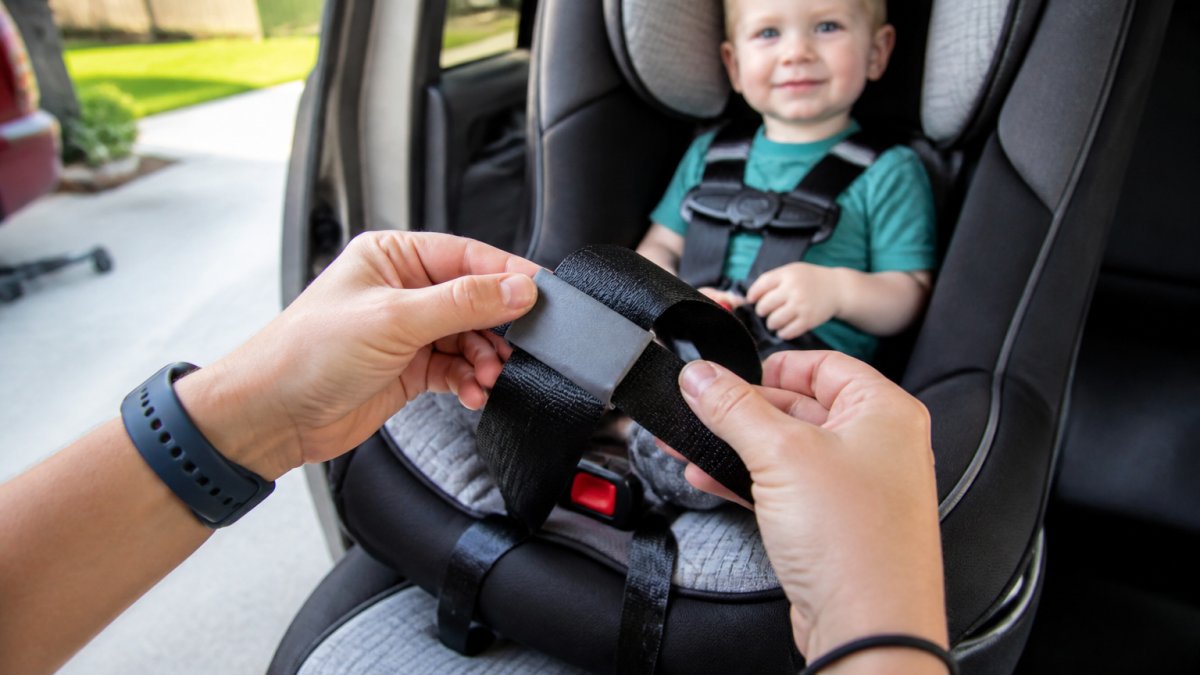
Fix 1: Flatten the webbing at every buckle. Twists start when the strap folds as it passes through the buckle tongue.
Fix 2: Use a strap aligner designed for the harness. This is where BuckleBuddeez fits. Our slim silicone sleeves hold the webbing flat so the buckle stays upright and reachable.

Fix 3: Check harness routing against the manual. A strap routed through the wrong slot twists no matter how careful you are. Follow the American Academy of Pediatrics car seat guidance on proper fit and routing before you blame the equipment.
Car Seat Strap Aligner Accessory →
Adjusting the Crotch Buckle and Harness So the Buckle Stays Reachable
Adjusting the crotch buckle is the step most parents skip, and it is often the real reason the buckle disappears.
Before you adjust anything, diagnose why the buckle is buried. The fix is different depending on the cause, and a visual check saves you from chasing the wrong problem.
Visual troubleshooting: is the buckle buried by routing or by design?
- Routing problem (most common). Look at the webbing as it passes through the buckle tongue. If you see a fold, a twist, or the strap entering the tongue at an angle, the buckle is being pushed down by the strap itself. Run your thumb along the webbing from the shoulder down to the tongue. A flat strap that enters the tongue straight is a routing fix, not a hardware fix.
- Fit problem. With the harness snug, check where the buckle sits relative to your child's body. If the buckle tongue rests on the belly or floats above the thighs instead of lying flat against the hips, the crotch position is wrong for your child's size. This is a seat-adjustment fix.
- Design problem. Some seats have a deep crease between the backrest and the seat pan, and the buckle naturally falls into it when the harness is loose. If the strap is flat and the fit is correct but the buckle still drops, the seat geometry is working against you. This is where a strap aligner that holds the webbing upright helps, because it keeps the buckle from folding into the crease.
Work through this checklist once you know which problem you have:
- Move the crotch buckle to the position closest to your child without pressing into their body. The buckle should sit flat against the hips, not dig into the belly or thighs.
- Set harness height so the shoulder straps sit at or just below the shoulders for rear-facing, and at or just above the shoulders for forward-facing.
- Tighten until you cannot pinch slack at the shoulder (the buckle pinch test).
- Confirm the chest clip sits at armpit level, not on the belly.
- Check the strap is flat through the buckle tongue before every trip.
A snug harness is not just safer. It also keeps the buckle from sliding out of reach, because there is no slack for it to travel into.
Escape Artists and Unbuckling: Behavioral Fixes Backed by Child Passenger Safety Experts
The escape artist phase is developmental, not a discipline problem. Toddlers test limits, and a buckle is a limit they can reach. Understanding why your child unbuckles helps you pick the right fix instead of cycling through random tips.
Most escape behavior falls into three buckets:
- Discomfort. A twisted strap, a buckle digging into the hip, or a chest clip riding too low creates a physical annoyance a toddler cannot articulate. They unbuckle to make it stop. This is the most common trigger and the easiest to fix with the harness adjustments above.
- Boredom. A child with nothing to do in the car finds the buckle the most interesting object within reach. The click is satisfying, and the reaction it gets is even better.
- Curiosity and control. Around age two, children discover they can make something happen. Unbuckling is a cause-and-effect experiment, and your reaction is part of the result.
That is why behavioral intervention matters as much as hardware. Match the fix to the trigger:
- Fix discomfort first. Before any behavioral strategy, confirm the harness is snug, the strap is flat, and the chest clip is at armpit level. A child who is physically comfortable has less reason to reach for the buckle.
- Practice at home. Let your child buckle a stuffed animal's "car seat" so the motion becomes familiar and boring. Novelty is fuel for the curiosity phase.
- Name the rule once, calmly. "We stay buckled until the car stops." Repeat it without a lecture. A long explanation gives the behavior more attention than it deserves.
- Give a job. A child with a task, like holding a snack or choosing the music, has less attention for the buckle. This targets the boredom trigger directly.
- Pull over safely if it happens. Stop when you can, rebuckle without drama, and continue. The consistency does the work, and the lack of a big reaction removes the payoff for the control phase.
If your child can unbuckle a properly fitted harness, that is a sign to consult a certified child passenger safety technician. They can check fit, confirm the seat is right for your child's size, and rule out a harness problem masquerading as behavior.
Conclusion
A buried buckle is a daily frustration, but the fix is not a cover or an extender. It is a harness that stays flat, a buckle at the right height, and a strap accessory that was actually tested with the seat.
That is the whole case for BuckleBuddeez. Our patented silicone aligners keep webbing flat so the buckle stays upright and easy to reach, even with a sleeping infant.
Get started with BuckleBuddeez and end the daily dig for a buried buckle.
Frequently Asked Questions
How can I keep car seat buckles from getting buried under my child?
Start with the harness itself: tighten the straps so you can't pinch webbing at the shoulder, and check that the crotch buckle is in the slot that sits closest to your child without pressing into them. Loose straps and twisted webbing are the two leading causes of buckles sliding under a child. A manufacturer-tested strap aligner like BuckleBuddeez ($29.99) keeps webbing flat and the buckle upright, so you're not digging for it every trip.
Are car seat buckle covers safe to use?
Most are not. Chest clip guards and buckle covers are not approved by most car seat manufacturers and may interfere with how the seat performs in a crash. Before adding any accessory, check your seat's manual and confirm the product has been tested to Federal Motor Vehicle Safety Standard 213. If a cover changes how the buckle releases or how the harness routes, skip it. A product that keeps straps flat without covering the release mechanism is the safer approach.
Can I use a hair tie or DIY hack to keep car seat straps in place?
No. Unauthorized items like duct tape or knots can compromise the structural integrity of the car seat during a crash. A hair tie or rubber band adds tension the seat was never tested with, and it can slip into the buckle housing. If twisting is the problem, address it with a tested accessory or a replacement harness from the manufacturer, not a household fix. Approximately 10% of children ride with a car seat misuse, and DIY fixes are one common cause.
What should I check before using a car seat accessory?
Four things: whether your car seat manual allows it, whether it has been crash tested to FMVSS 213, whether it touches the buckle release or harness routing, and whether it stays in place without readjusting. BuckleBuddeez, for example, passed dynamic crash testing on FMVSS 213 sleds with a measurable reduction in chest g-force acceleration, and it fits most standard five-point and special needs harnesses. If a seller can't answer those four questions, don't put it in your car.
