

How to Choose a 2-in-1 Harness Booster Seat
Last Updated: October 26, 2026
Quick Summary
Compare a harness booster seat by lining up four numbers: harness weight range, harness height limit, top harness slot height, and booster weight and height range. The harness stage ends at whichever limit your child hits first, so check that the booster minimums are met before switching modes.
- The harness stage ends at the harness weight maximum, standing height limit, or top harness slot, whichever comes first.
- A wide gap between the harness maximum and booster minimum can leave your child in neither mode cleanly.
- Switch to booster mode only after your child meets the booster minimums and has outgrown the harness.
- Check harness tightness with the pinch test at the collarbone, keeping the chest clip at armpit level.
- In booster mode the seat is usually not installed with LATCH; the vehicle belt restrains child and booster.
Table of Contents
- What a 2-in-1 Harness Booster Seat Actually Does
- Harness Booster Seat Weight and Height Limits to Compare
- When to Switch From Harness to Booster Mode
- 5-Point Harness vs. High-Back Booster: What Changes for Your Child
- How to Check Car Seat Harness Tightness
- Installation, LATCH, and Mode-Specific Misuse to Watch For
- Picking the Right 2-in-1 Harness Booster for Your Family
- Frequently Asked Questions
What a 2-in-1 Harness Booster Seat Actually Does
A 2-in-1 harness booster seat is a forward-facing child seat with two modes: a five-point harness for younger children, then a belt-positioning booster once the child outgrows the harness. It covers two stages of growth, which is why many families buy one instead of two seats.
"2-in-1" does not mean the seat grows with your child forever; it means the seat has two distinct jobs, and the switch between them is your decision, not something the seat does on its own.
What matters: harness mode has hard weight and height limits, and once your child passes them, the harness is no longer safe to use, even if the seat still fits in your car.
Forward-Facing Harness Mode vs. Belt-Positioning Booster Mode
In harness mode, the seat's own five-point harness holds your child; you adjust, tighten, and buckle it yourself, and the vehicle seat belt holds only the seat. In booster mode, the harness is removed or stowed, and the vehicle's lap and shoulder belt restrain your child; the booster's only job is to position that belt correctly across the shoulder and hips.
Harness Booster Seat Weight and Height Limits to Compare
Harness booster seat weight and height limits decide how long harness mode lasts. Every 2-in-1 seat lists a forward-facing harness weight range, a standing height limit, and a separate booster range.
Shopping by weight alone is a problem. For a deeper look at choosing a harness booster for a secure fit, see What Is the Best Harness Booster Seat for Secure Fit?.
When you compare seats, put these four numbers side by side:
- Harness weight range: the minimum and maximum forward-facing weight for harness use
- Harness height limit: the standing height at which the harness must stop being used
- Top harness slot height: how high the shoulder straps can move, which caps real-world fit
How the Four Numbers Interact
The harness stage ends at whichever comes first: the harness weight maximum, the standing height limit, or the point where your child's shoulders rise above the top harness slot.
Booster mode has its own floor: a minimum weight and often a minimum height or age.
For each candidate seat, write the harness maximum and the booster minimum next to each other.
A Side-by-Side Fit Worksheet
Rather than memorizing specs, build a one-page worksheet for every seat on your shortlist, filled in from the manufacturer's fit chart and manual:
| Row to fill in | Where to find it | Why it matters |
|---|---|---|
| Forward-facing harness minimum weight | Fit chart | Prevents starting harness mode too early |
| Forward-facing harness maximum weight | Fit chart | One of three ways the harness stage ends |
| Harness standing height limit | Fit chart | Often ends the harness stage before weight does |
| Top harness slot height | Manual or seat label | Caps real-world shoulder fit |
| Booster minimum weight, height, and age | Fit chart | Prevents switching to booster mode too early |
| Booster maximum weight and height | Fit chart | Tells you when the seat is fully outgrown |
| Expiration date | Label on seat shell | Caps usable lifespan across both stages |
Once the worksheet is filled in for three or four seats, the shortlist usually collapses on its own. The seat that fits your child with room to grow in harness mode, then picks up in booster mode without a dead zone, is the one worth a test fit.
The [National Highway Traffic Safety Administration's child seat guidance | nhtsa.gov] is a useful starting point for understanding why height and weight both matter, not just one. For the transition decision itself, see the next section on when to switch from harness to booster mode.
Reading the Fit Chart Before You Buy
Manufacturer fit charts are the legal and engineering boundary of the seat, and using a seat outside them is misuse.
Read the chart in this order: forward-facing minimum weight, forward-facing maximum weight, harness height limit, then booster limits. Write those four numbers down for every seat; the shortlist shrinks fast once they are on one page.
When to Switch From Harness to Booster Mode
Switch from harness to booster mode only when your child has reached the seat's booster minimums and has outgrown the harness by weight or height, whichever comes first.
Age matters too. A booster relies on the child sitting upright for the whole trip, and many safety organizations advise keeping children in a harness as long as the seat allows.
The practical test is simple: if your child still fits the harness within the seat's limits, keep using it.
5-Point Harness vs. High-Back Booster: What Changes for Your Child
The shift from a 5-point harness to a high-back booster changes who holds your child in a crash. In harness mode, the seat's straps hold the child against the shell.
What changes for your child, in plain terms:
- Restraint: five straps become one lap belt and one shoulder belt
- Responsibility: the seat restrains the child in harness mode; the child helps keep the belt positioned in booster mode
- Head and neck support: a high-back booster provides a shell behind the head, which matters in vehicles with low seat backs or no head restraint in that position
A backless booster removes the high back entirely, so it depends even more on your vehicle's seat and head restraint. That is why a high-back booster is usually the safer starting point when a child first moves out of the harness.
How to Check Car Seat Harness Tightness
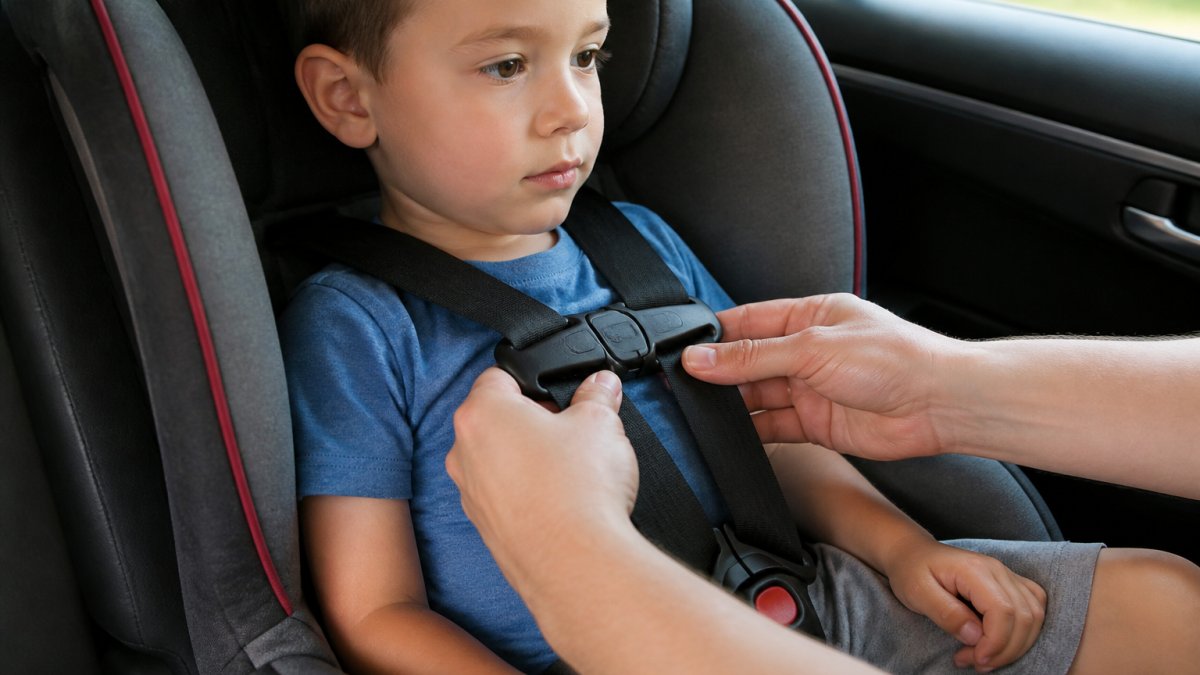
Check harness tightness with the pinch test: buckle your child in, pull the harness adjuster snug, then try to pinch the strap webbing at the collarbone.
A snug harness lies flat against the body with no slack at the hips or chest. The chest clip sits at armpit level, and the shoulder straps come out at or just below the child's shoulders in forward-facing mode.
Two things quietly ruin a good fit. Twisted webbing folds over itself at the buckle or chest clip, cannot tighten evenly, and leaves one side looser than the other. Bulky clothing compresses in a crash and leaves the harness loose when it matters.
That twisted-webbing problem is exactly what we built BuckleBuddeez around.
Installation, LATCH, and Mode-Specific Misuse to Watch For
Installation errors change by mode, and that is where most misuse happens. In harness mode, the seat is installed with the vehicle belt or LATCH lower anchors plus the top tether, and its own harness restrains the child. In booster mode, the seat is usually not installed with LATCH at all; the booster sits on the vehicle seat and the vehicle belt restrains both child and booster. Readers with installation or misuse questions can check the site's Faqs page for quick answers.
Harness Mode Installation
In forward-facing harness mode, the seat is an installed child restraint: tight at the belt path, with the recline or level indicator in the allowed forward-facing range, and the top tether used whenever the seat and vehicle both allow it.
Check the install by grabbing the seat at the belt path and trying to move it. A correctly installed forward-facing seat should move no more than about an inch front to back and side to side at the belt path; movement at the top of the seat back is expected.
Booster Mode Installation
In booster mode, the seat is no longer an installed restraint. It sits on the vehicle seat, and the vehicle's lap and shoulder belt route through the booster's belt path or shoulder belt guide. The booster positions that belt; it does not hold the child in place on its own.
This is where the mode-specific mistakes cluster:
- Using LATCH in booster mode when the manual says the lower anchors are for storage only. A tethered or anchored booster can be pulled out of position, and the belt may not route cleanly.
- Skipping the top tether in forward-facing harness mode when the seat and vehicle both allow it.
- Routing the belt through the wrong path in booster mode, such as missing the shoulder belt guide or letting the lap belt ride over the armrest instead of through the lap path.
Belt Routing in Booster Mode
The shoulder belt must cross the middle of the shoulder, and the lap belt must sit low across the hips, touching the thighs, not the belly. A high-back booster's shoulder belt guide keeps the belt off the neck; a backless booster relies on the vehicle's belt geometry and head restraint. If the shoulder belt crosses the neck or falls off the shoulder, the booster is not positioning the belt correctly for that child in that vehicle.
Vehicle Fit and Three-Across Realities
Seat width, buckle access, and vehicle-seat shape decide whether a 2-in-1 works in your back seat. A seat that installs cleanly in a captain's chair can be a fight in a three-across bench, where the buckle stalk may be buried and the seat may not sit flat on a contoured cushion.
The [Insurance Institute for Highway Safety's booster seat ratings | iihs.org] are worth checking before you buy, because they assess how well a booster positions the lap and shoulder belt on a test dummy rather than how it looks on a shelf.
Picking the Right 2-in-1 Harness Booster for Your Family
Pick a 2-in-1 harness booster by matching its fit limits to your child's current height and weight, then checking how it installs in your actual vehicle.
Use this checklist before you commit to any seat:
- Harness weight limit and height limit both fit your child with room to grow
- Top harness slot height is above your child's shoulders today
- Booster mode minimums are realistic for your child's age and maturity
That last point is the one shoppers forget. Every seat has an expiration date, and a 2-in-1 only pays off if its usable lifespan covers both stages for your child.
Once you have your shortlist, you can browse specific 2-in-1 options like the Paw Patrol Skye 2-in-1 harness booster car seat to see how the features line up with your checklist.
Choosing a 2-in-1 harness booster seat comes down to fit limits, mode-specific installation, and a harness that stays flat and snug trip after trip.
Frequently Asked Questions
How long should a child stay in a harness booster seat?
Keep your child in the forward-facing five-point harness until they reach the seat's top harness weight or height limit, typically around 65 pounds and 49 inches on many 2-in-1 models. After that, switch to belt-positioning booster mode. Many safety advocates suggest using the harness as long as the seat allows, since a five-point harness spreads crash forces across stronger parts of the body. Check your specific seat's manual for the exact limits before making the switch.
Is a 5-point harness safer than a high-back booster?
For younger or smaller children, a five-point harness is generally the safer choice because it holds the body in place with five contact points and limits forward movement in a crash. A high-back booster relies on the vehicle's lap and shoulder belt, which only fits properly once a child is tall enough for the belt to cross the shoulder, not the neck. That is why most 2-in-1 harness booster seats are designed to be used in harness mode first, then converted to booster mode as the child grows.
What should I compare when choosing a 2-in-1 harness booster seat?
Compare harness weight and height limits, booster-mode minimums, seat width for three-across fit, LATCH and top-tether compatibility, and how easy the harness is to adjust. Also check the expiration date, since most seats last 6 to 10 years from the manufacture date. Look at the buckle position and how accessible it is, because a buried buckle slows down every trip. Finally, read the manual for installation requirements in each mode, since harness mode and booster mode often use different attachment methods.
How do I know if my car seat harness is tight enough?
Use the pinch test: buckle the harness and tighten it, then try to pinch the webbing at the shoulder or chest. If you can grab a fold of strap between your fingers, it is too loose. The harness should lie flat with no twists, and the chest clip should sit at armpit level. Twisted straps are a common reason a harness feels loose even when tightened, so check that the webbing runs flat through the buckle and adjuster before each trip.
